
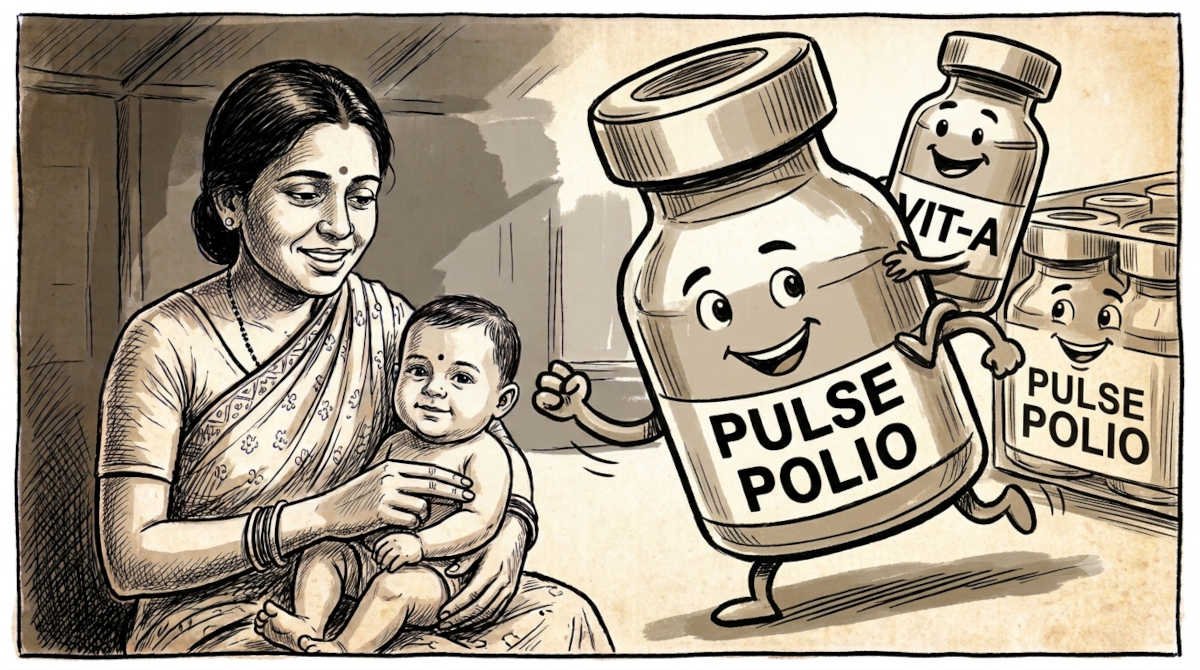
The case of Vitamin A supplementation piggy riding the Pulse polio campaign
This is one more illustration of the huge role chance plays in policy making.
Just recently, I attended a round table on Climate resilient and Nutrition sensitive Food systems at the Swaminathan Research Foundation (MSSRF). It gave me a sense of déjà vu.
Decades ago in 1998, I attended another round table on nutrition in the same premises. A chance meeting and a leisurely evening stroll in the garden with Dr M K Bhan, an ace pediatrician, resulted in an interesting policy initiative; combining Vitamin A and Pulse polio campaign to improve the coverage of Vitamin – A supplementation among children.
During the 90s, night blindness among children was an issue of concern, and Vitamin-A supplementation was the solution. Yet the Vitamin-A coverage among children was very low, and Dr Bhan was rightly concerned about it. But his advocacy efforts to improve Vitamin-A coverage were not making much headway. He had not yet become Secretary to Government of India, which he eventually did in 2004. His tenure as Secretary DBT is remembered as ‘golden era’ of bio-technology.
Back to the 1998 round table. Dr Bhan caught up with me in my brisk walking and said "Chief – ek gujarish hai" (Chief, there is a request). The ‘Chief’ bit was addressing the Secretary, Women and Child Development in Government of Odisha, which I then was.
"Hukum kijiye" – I responded in the traditional style to the ‘gujarish’.
"Can we try a very doable idea – combining Vitamin – A supplementation with the pulse polio campaign. Given your concern about night blindness, I thought I could suggest this to you." He was referring to my outpourings in the morning session about night-blindness where I narrated my experience both as a probationer in Ganjam district and again as the Sub-collector Jajpur, my first posting.
As IAS probationer, I had visited few tribal villages in Ganjam. Everywhere, I could spot a child or two having difficulty in seeing after the evening. This was also the case in some of the coastal habitations, but not quite so in non-tribal villages. I carried that information at the back of my mind when I became the sub-collector and did a reality check while visiting the tribal blocks of Sukinda and Dangadi.
Unsurprisingly, I could identify some of the children with the same problem; night blindness! The BDO apologetically said that this needs be looked into. They did have Vitamin – A stocks and he would see to it that the children get Vitamin – A. But on coming back to the block headquarter, he found that the Vitamin – A stock available had crossed its expiry date. I promised to send him a fresh stock as soon as possible from Jajpur, the sub divisional headquarter.
"We don’t have any problem of night blindness in Jajpur" informed my smug SDMO, the sub-divisional medical officer. "These cases must be the few and far between. I will send fresh stock of Vitamin-A quickly. We will place an indent with the district office for it!"
As irony would have it, a worker in a nearby hotel who used to get us snacks, came to my residential office a couple of days later with his small daughter in tow. ‘Why does she not go to the school?’ was the usual ‘upper crust’ question of mine.
"She has problem in seeing. What will she do going to the school?" was the nonchalant reply.
Pronto! I sent her to the SDMO immediately in my jeep to see what can be done. "She needed to be given Vitamin-A long time back. But let me see what I can do."
So here I was, the Sub-collector, watching the smugness of the medical establishment and co-existence of children with night blindness and an expired Vitamin-A stock. I remained sensitized to this issue, later as Collector, and then when I joined as Secretary WCD.
Dr Bhan saw an opportunity in these outpourings. He must have tried to convince people in different quarters and must have found it difficult. Here was a sensitized policy maker, who might just buy his idea. I was cautious, however. "Is there any catch? I mean is it safe?"
"Oh, yes. It is safe." He pinched his neck between the thumb and the index finger in the ‘I swear by it’ gesture. If he was vouching for it, it must be so, I reasoned. But the cautious bureaucrat inside me wanted to play safe. "Why not ‘patao’ the central government? That will make life easier."
"Wohi to problem hai. They would like to see some pilot, before they will think about it. But since you are aware of the problem and Odisha has this problem, I thought I can broach this topic with you. You are the Secretary WCD, and the Anganwadi workers play a crucial role in the pulse polo campaign. So, your help will be crucial. And, by the way, Vitamin – A has many more advantages, not just the night blindness problem."
I did not need to know these advantages. Reducing night-blindness, particularly among the poorer children, was enough justification for me. The Anganwadi workers would of course participate. But I had a doubt. "What would be the sequence? Vitamin – A drops first or Polio drops first, and, are these to be administered together or with a gap."
"There is a gap, but why this question?" It was his term to be surprised.
"Dada, if you give the child Vitamin-A drops first, the mother will not wait for the polio drops. But if the child is given polio drops and told that the child will now be given Vitamin drops, she will patiently wait for 5 to 10 minutes."
"Oh, I didn’t think about this angle. Luckily, the sequence we have in mind is Polio drops first, followed by Vitamin-A drops since I don’t want to disturb the pulse polio campaign. The gap between the two can be 8-10 minutes, that’s safe and adequate."
"That’s useful. I think this is quite doable. Main karata hoon isko, but I need to talk to the Health Secretary. There buy in is crucial. But would you help nudge Delhi about the Vitamin-A supply chain?"
Dr Bhan was somewhat surprised at this quick response, pleasantly of course. We parted with the caveat that I would need to convince the Health Department first for this joint campaign. But I was quite confident that this can be done.
Health Secretary, Meena Gupta, was a very fine officer and senior to me by 8 odd years. She had a good opinion of my work. We had in fact written a joint letter addressed to both ICDS and Health staff in the field about immunization. Convincing her was relatively easier, particularly when the idea was vetted by someone like Dr Bhan.
Odisha had its first combined campaign in 1999 and the initiative continued. The strategy of giving polio drops first and then Vitamin A, was quite effective. Most mothers would wait for the Vitamin-A drops and not walk away after the polio drops had been given. Coverage under Vitamin-A supplementation hugely increased riding piggy-back on the Pulse Polio campaign. There was a sharp reduction in incidences of Bitot’s spots - a clear indicator of reduction in night blindness. The campaign continued.
I in the meantime got transferred as Secretary of Personnel (General Administration) Department and subsequently went to Kolkata as a Consultant to UNICEF on secondment basis as an expert on child undernutrition and data analytics. The Jurisdiction of the Kolkata office extended to Assam as well.
Looking at the encouraging results in Odisha, UNICEF did advocate for a similar campaign being taken up in Assam. These efforts succeeded. The first campaign was done in November 2000. It was received well. Everybody was happy. The UNICEF Chief in Kolkata office, Carrie Auer, was quite happy with the advocacy efforts.
But new initiatives do sometimes hit unexpected air pockets. A second round of the campaign which was a standalone, mega dose Vitamin-A campaign in November 2001, saw death of about 15 odd children and a number of children becoming unwell after administration of the mega dose of Vitamin-A. There was an uproar. Media was quick to blame it on the campaign even when there was no clear linkage. Someone went to the High Court in a PIL. The Court issued notices to the Government as well as to the UNICEF Chief in Kolkata asking for personal appearance.
The UNICEF Chief was understandably worried. She would have faced a hostile press if she visited Assam. The PIL in the High Court could be a long-drawn affair. Some of her senior colleagues advised her to attend at least the first hearing as a mollifying gesture seeking exemption from it in subsequent hearings. The Nutrition Programme Officer, a relatively junior officer, suggested that she should talk to me given my administrative background.
I was clear that the UNICEF staff enjoyed certain diplomatic immunities in Countries where they worked and seeking the Chief’s personal appearance in the Court was not tenable in law. To be on the safer side, however, I suggested that she consults the India Office in New Delhi and gets a confirmation on this. At the same time, as a matter of prudence, it was a good idea to engage a senior lawyer at Guwahati only to bring to the notice of the Hon’ble Court, the legal provisions and the untenability of legal proceedings against her, given the diplomatic immunity.
My view was confirmed by the Delhi office. UNICEF staff heaved a sigh of relief, but the Vitamin-A campaign got a bad name. Health Departments became cautious. The idea of combining administration of Vitamin dosage with pulse polio campaign was dropped, even in Odisha, apprehending a drop in the polio coverage – a risk no one would want to take.
Looking back, UNICEF Kolkata should have continued the combined campaign like Odisha did, instead of rushing into the stand-alone, mega-dose campaign. Pulse Polio campaign, even today, is closely supervised and carefully carried out and that kept the Odisha campaigns hiccup free. But such wisdom usually comes only by hindsight. Today Vitamin-A dosage administration has been integrated with routine immunization. It does not need to piggy-ride the pulse polio campaign.
The Odisha case illustrates the role chance plays in policy making. My chance meeting at Chennai, triggered this policy initiative. But then Dr Bhan had also done his homework well. So when the chance came, he could capitalize on it. Me being in good books of the health Secretary and my experience about the night-blindness in early years of service were also part of the chance.
More importantly, there is no room for complacence even after a policy initiative happens. One needs to be ready for air pockets and, as the saying goes, clear air turbulence is more dangerous.
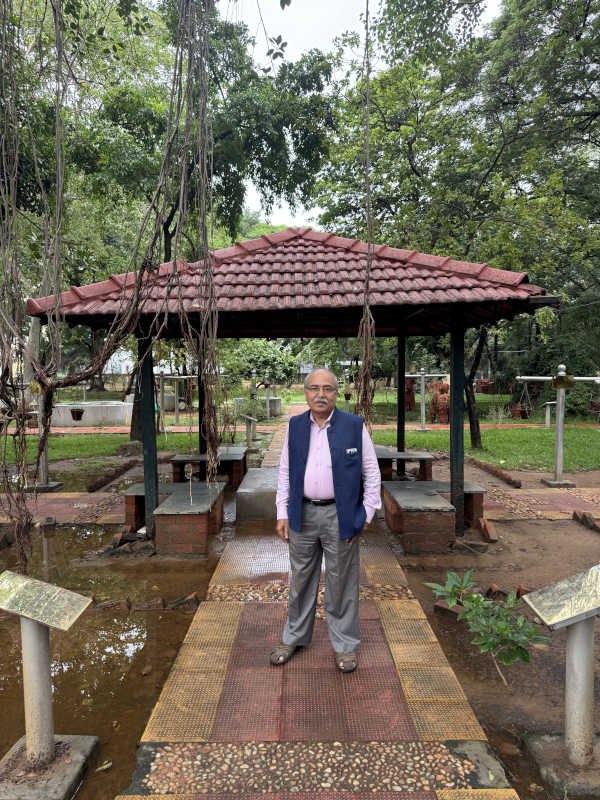
It is also a chance, that this chain of thought got triggered in the same garden where you can see me in the photograph. The 1998 round-table was convened by MSS himself, this time it is Dr Soumya – his daughter. I am reminded of the title of an old popular science book "This chancy, chancy, chancy world!"