
I have held a number of posts that combined regulation as well as development in a sector. Urban development, Industries, Environment, Transport, Shipping all fell in this category. I had to regulate the sector and also develop it. I therefore, had the unenviable task of bringing reforms while dealing with the technical cadre who were competent, experienced but could be corrupt as well, with some exceptions as usual. Interestingly, most technical officers would consider me as ‘one of us’, given my IIT background, my work in renewable energy sector and my habit of discussing technical details at length with them.
In most of these assignments I tried to make life easier for the law-abiding clients, reduce delays and minimize corruption; no pretension of eliminating it. Insincere politicians can make such promise. Good luck to them.
Director Industries was one such post. The office was in Cuttack. Prior to joining it in 1990, I was the Vice Chairman of the Cuttack Development Authority. My reputation as a friendly, innovative, but tough administrator had preceded my joining. The Directorate had jurisdiction over all the District Industries Centres (DIC), headed by a General Manager. It also dealt with the Industrial promotion entities of the State Government.
80s was still an era of physical files and papers. Cases would be processed in the districts. Proposals would come to the Directorate, get scrutinized and approved. If there were queries, matter will again go back to the districts. These were time taking processes and what was worse, conferred advantages to those in the proximity of Bhubaneshwar and Cuttack. Industries in distant districts were at certain disadvantages even when located in the industrial belt of Jharsuguda-Rourkela in the northern division or the Ganjam-Rayagada in the south. I used some unorthodox techniques to tackle it.
I would fix long distance tours such that I spent few hours each in two or three DICs en route to my destination. There I would review the overall MSME programme in the district, matters pending at the Directorate or matters that needed the approval of the Director and also meet 4-5 entrepreneurs who may have any grievance. I would also carry files related to that district where the DIC had been asked to respond to some queries.
My experience has been that a majority of cases are usually straightforward to deal with. But these go through the same lengthy scrutiny procedures. Additionally, as the GMs of the District Industries Centres, were senior enough in rank, I as the Director could take their word for the ‘green channel’ proposals without having to depend upon long multi-level scrutiny in my office. So, I happily gambled along. I would go through the proposals, discuss these with the GM DIC and his officers, talk on phone with my senior officers in Cuttack if needed and take a decision on the file right at the DIC itself. The DIC was considered as my ‘Camp Office’ for that duration. I will initiate what is called a ‘part – file’ and record my decision. As I left for the next leg of my tour, all the part files will head back to Cuttack through one of the DIC staff to be received and merged in the main file. One precaution that I took was that all positive approvals, vetted by the GM, were cleared in the camp office itself while all disapproval files were sent to Cuttack for more detailed scrutiny.
As a result, in each of my tour, I would cover 5-6 districts. The file movement to Cuttack reduced for the ‘clean’ cases. The concerned applicant did not have to run to Cuttack to ‘follow up’. The DICs felt empowered. In fact, liked the partial autonomy from the control of the Directorate. The staff at the Directorate was not very enthused by this unorthodox approach, but they did not have much choice. The file processing speeded up quite a bit.
Of course, there was a flip side for the District Office too. The DICs could not play God. My tour programme used to be communicated well in advance. The local Industry Association would know about it. Besides the brief ‘open door’ session for the entrepreneurs from that district also put some heat on the local office. They could not hold the files back and had to keep all the ‘green channel’ proposals ready, lest I question them why some were left out.
This approach really paid dividends and our throughput went up significantly. My Chartered Accountant friend complimented me for this simple trick. He also observed an unexpected side effect. “You know in these things ‘len den to chaltaa hai (money does change hands)’, but you have brought the scale of corruption significantly down. Moreover as the files don’t need to move to Cuttack, the transaction cost has also come down.” His observation did not quite surprise me. But what he told next did surprise me. Once my tour programme was known, the ‘green channel’ cases would patiently wait for their case to be processed as they knew that their file would not be held back for very long period. The DIC staff also knew it and would as a consequence be happy even with a much smaller ‘len den’ which in my friend’s words was “better than not getting anything”. In fact, many cases started getting processed even without any consideration being paid.
This gave me an interesting idea. Those days, a new but larger industry needed to get a certificate called the GIP (Gone Into Production) Certificate from the Directorate. Ideally, the larger the number and quicker the certificate was given, more would be the industrial growth in the State. But such consideration did not motivate the bureaucratic supply chain; their considerations would be different. As a result, the GIP files would go through a maze of regulatory and inspection procedures at their own sweet pace. Almost all of these files would come to the Directorate after due scrutiny from two parastatals – The Industry Development Corporation and the Electronic Development Corporation, both headed by Senior IAS officers. But these will again go through a round of scrutiny in the Directorate. My query as to why does the Directorate need to do another detailed scrutiny, was answered by a very righteous reply. “They are Corporations, Sir, not Government. We are the ones who should have the final authority.” Clearly, we were looking at industrial promotion through the lens of the Inspector Raj!
“Do you find shortcoming in their scrutinies?” I asked. Yes, many were found. But these were not serious in nature and mostly procedural. I then asked my office to prepare a check-list of frequently observed shortcomings for both electronic and other Industries and took it to the two Corporation Heads. I had a simple request. The Corporations should use the checklist, ensure that the shortcomings have been addressed and certify the proposals to this effect. Then the Directorate need not do this scrutiny again.
“You mean to say, your guys won’t sit on the file just because I certify?” this was the usual Mr Menon, Chairman of the Electronic Development Corporation, an upright senior officer but always suspicious of any new ideas.
“Why not Sir? Tomorrow I may be in your Chair and vice versa? Why should I distrust your certification? You are an equally responsible officer Sir.” That mollified him. IDCOL MD was also happy with this proposal.
My other request was that all the current cases be sent to my office in one lot, rather than individually. We got a total of some 100 cases.
I called all the concerned officers, the Joint Director, the Deputy Director the Assistant Director and the Section Officer and asked them to go through the files in a ‘drive’ mode. The Certification from the two parastatals were to be accepted as it is, except for few random verifications. Unsurprisingly, the task took much less time and all files, except 2 or 3 of were fit for being granted the GIP certificate.
I got all the files ready with all noting and approvals and got the hundred odd Certificates printed with required signatures. I then called one non touring officer dealing with the GIP certificates. Let us call him Mr Singh. I said “Mr Singh, all Certificates are ready. These do not need any presence of any senior officers for handing these over to the client.”
“No, Sir, these are clear cases now.”
“Okay, I will now authorize you to be the single node to hand over these certificates to the Industry representative. Take all these files in your custody. Whoever comes for the GIP Certificate will come and meet you. Receive the application and hand over the certificate. You are an efficient officer and can do this speedily.”
“Yes Sir.” Mr Singh was not sure where it was heading.
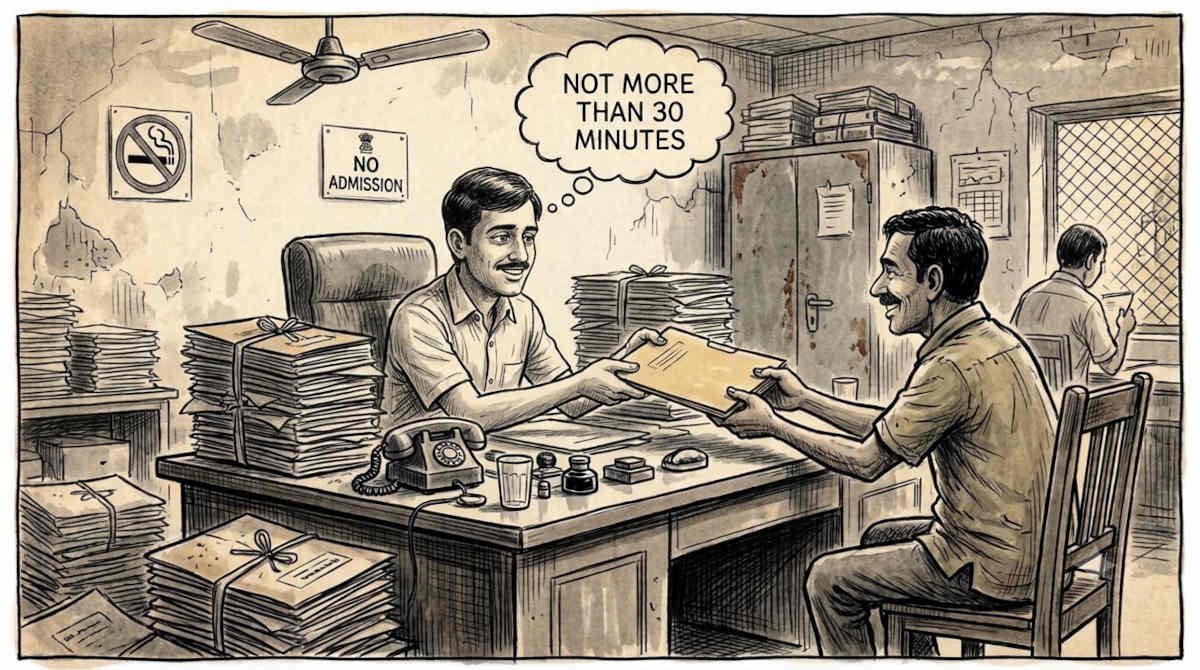
“I just have one condition. Whoever comes to take these certificates should not hang on for more than half an hour inside the Directorate premises. Is that clear? At 31st minute the fellow should be out of our premises, if not earlier. What else you do is your problem. But 30 minutes max!” I re-emphasized.
“I don’t do anything Sir, I am a very God-fearing person” was the meek reply of Mr Singh. Both of us knew that it was not the reality.
“30 minutes max. Now take away all these files.”
Once again my CA friend came over. “What have you done to your office?” He asked. “Your GIP Certificates …”
“Any problem?” I interrupted.
“No, no. The industry people are quite happy. They are getting their certificates hassle free.”
“That’s a good thing. Isn’t it?”
“Yes, certainly.” He said “But there is something else going on. Your guys are quite quick and bit jittery about the whole process. They kind of shoo away the visitors very quickly. Earlier there used to be multiple trips, elaborate ‘chai paani’ – you know what I mean.” He paused. “Now this is just one visit, and that is all.” He sounded genuinely puzzled.
I told him about the ready-to-hand-over Certificates and the ‘30 minute’ time limit.
“But tell me. What about the corruption?” I asked.
“Why embarrass me? He was little uneasy. “Yes, it is there but has come down drastically. But my clients are even more happy about something else – it takes just one visit now.”
“How does that help?” I was a bit puzzled.
“You see, Sir. Private sector also has its own corruption. The Gumasta who follows up the case often inflates the number of trips and keeps billing for multiple ‘chai paani’. Now with just one trip, that cost is saved too. Hamare yahaan bhi corruption hotaa hai. Bus halla nahee hotaa.”
That was some learning for me.
I narrated this experience to a batchmate who remarked very solemnly “This is very wrong. You knowingly encouraged corruption in your office. We have to be impeccably clean!”
I haven’t found an answer to that question yet.
Satish B Agnihotri