
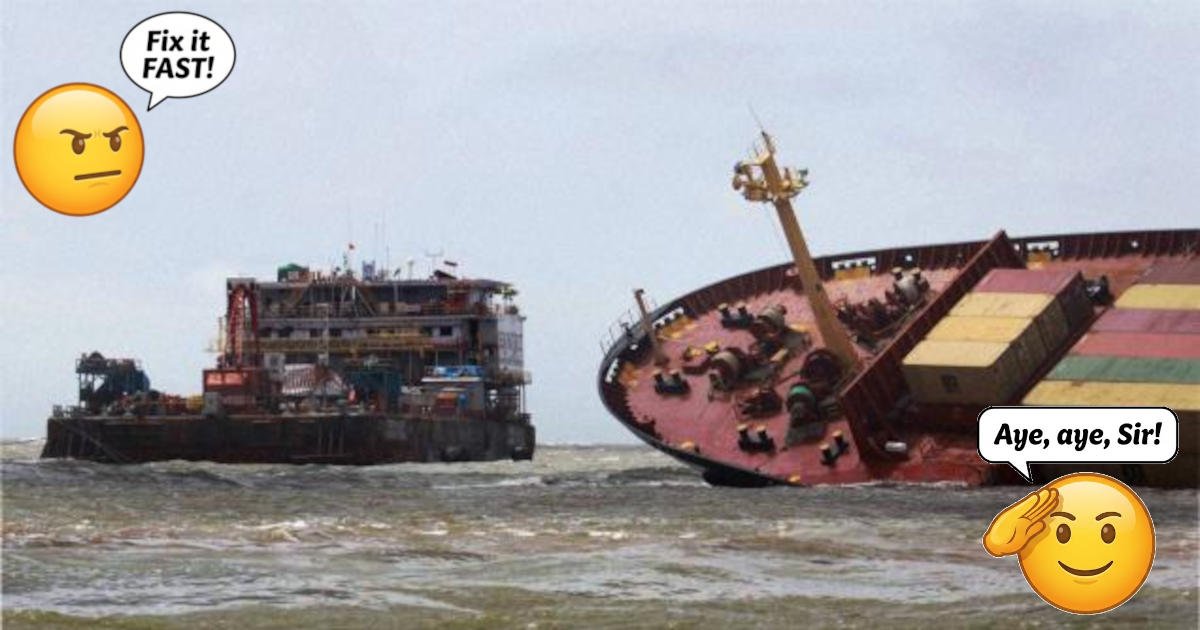
The big, freak, ship accident – when two ships collided, blocking Mumbai Port
It was certainly a big accident – perhaps the biggest in shipping history in Indian waters. Two ships collided blocking the navigation channel stalling any ship movement from Mumbai and JNPT, which accounted for nearly 2/3rd of the shipping by volume. Media cried shortages. Government was worried. A crisis management committee went into action.
The two ships collided as per Murphy’s second law – “if anything can go wrong in multiple ways it will go wrong in the most inconvenient way”. Could they not have chosen to collide at a ‘better’ location, sparing the Maritime Administration the agony of crisis management?
Murphy’s law certainly. The accident happened the day Secretary Shipping was in Mumbai which does not happen very often. And then, instead of having meetings in South Bombay, as usual, he had chosen to visit a training Institute a couple of hours drive from Mumbai for a function. How can the DG Shipping, i.e. me, not accompany him?
So, the blessed ships collided, exactly when both of us were away from the Jahaj Bhavan, my office in Mumbai and were not reachable on phone. The Cabinet Secretary, tried to reach us, and understandably could not. Without waiting to hear from us he fixed up a Video Conference at 2.30 pm to review the situation and steps to be taken!
We were informed of this meeting, requesting us to drop all engagements and rush back to attend the VC. “Which were the two ships?” I asked the DDG Captain Khatri. It was MV Chitra, Sir which was hit by MV Khalijia III.”
“Khalijia?” my jaws dropped. “The ship that we recently got rescued and anchored to a safe place for repairs? What on earth was it doing in the navigation channel?”
“Yes, Sir. The same Khalijia we got rescued. It’s in situ repairs were over and it needed to move to a dry dock in Mumbai for full repairs.”
“And the first task was to hit Chitra, is it?” I asked icily and with frustration. “Navigation Channel kaa kyaa scene hai? Please check with Captain Saggi, and brief me on SMS. We will come to the venue of the video conference directly.” Captain Saggi was our Nautical Advisor and a very competent, experienced and cool-headed officer. Even if we were delayed for the video conference, he would have briefed the Cabinet Secretary suitably.
We reached the VC just in time. The hall was full, with representatives of Navy, Coast Guard, Bombay Municipal Corporation, Maritime Board, State Relief Commissioner, Pollution control Board, officers from DG Shipping and our Mumbai office and various other offices. The CS was briefed about the situation with a grim news that the navigation of ships from and to Mumbai Port and JNPT would be stalled for a considerable time.
And then, as if it suddenly dawned on the Cabinet Secretary, he said, “Oh Satish, so you are the DG Shipping. Isn’t it? Good, so you can Head the crisis management committee locally and send a SITREP (situation report) every evening. You know the drill. How long would it take to resume the regular navigation?”
That was a bit tricky question. I politely said that I did not wish to speculate, but prima facie a fortnight would at least be needed, though industry is apprehending it to take a month or so. “You know the resources at your command” he said, “please expedite it. Double up as JS Cabinet Secretariat.”
It so happened that I was the JS in the Cabinet Secretariat before joining as Jt DG Shipping. There I was looking after Security related matters which included the National Crisis Management Committee, a lean but effective body activated during such crisis. ‘Knowing the drill’ referred to this context. So, it was decided that DG Shipping will do all the coordination and send a SITREP to Cabinet Secretariat every day and all other agencies will cooperate with his office. Strange it may seem, but explicit mention of such decisions in the minutes of the meeting is important in the administrative system so that there is no ambiguity as to who is the first among the equals. It helped me as well when the Head of one of the agencies asked me rather disdainfully the next day “Aap kaahe kaa coordination karenge? (What kind of coordination you think you will do?)” My reply was simple, one major coordination was to send the SITREP to the Cabinet Secretary everyday by 5 pm. If there are no inputs or indifferent inputs from any of the agency, the SITREP will highlight it as such. That polite but firm response ensured everybody’s co-operation!
Sometimes in July 2010, this ship, MV Khalijia III had run aground off Mumbai coast. It was refloated reasonably quickly by SMIT salvage Singapore, one of the best companies in the trade. However, it was not fully repaired and needed to move through the Mumbai harbour to a dry dock facility for full repair. It was during its inbound journey that it hit the outbound ship MV Chitra, a massive 40,000 tonne ship laden with Cargo. So, we had the specter of oil spill, a job that Coast Guard needed to handle with its attendant hazard, the containers fallen into the sea which could have had hazardous cargo that the owners had to handle.
This would be a tricky situation. Usually, Government agencies are slow when it comes to steps like engaging a lawyer. By the time they put their act together, the private parties have creamed away the experts. Surely, we could not afford it in this case where massive insurance claims would be involved.
Without loosing time, I called up Advocate Raja Majumdar of Mitra and Bose, the same afternoon. He was certainly the best available maritime lawyer in Mumbai then. I asked him if he had heard of the accident, to which he said yes. I came straight to the point, “has any ship owners approached you and engaged you yet?” He replied in negative. I told him bluntly “From this second, you are DG Shipping’s Lawyer. Send the relevant ‘kagaz’ for our signature on the ‘vakalatnama’. I don’t guarantee any high fees, but will pay whatever Government norms permit.” Poor Raja, he could not refuse. But he was completely game for this. He later represented the central and the state government entities as well, getting them some good compensation. Those days, officers could take such ‘rash’ decision in public interest in good faith and not repent. I wonder if I would do it now!
Having secured the legal front, next mundane but important thing was to inform the Centre in Colarado, US where I was to go for my training in Public Administration three days later. This was the fourth time that my going for the training was getting postponed (will narrate it some other time). The Centre was sympathetic and agreed for the postponement.
Next was the drill of identifying the owners, particularly of MV Chitra, and summon them for taking action on salvaging, removing the oil from the ship to minimize the spillage and take action on the cargo that had spilled into the sea. SMIT Salvage was there in the vicinity, thanks to the recent Khalijia III operation. They were the natural choice to tackle the mess. But the owners of Chitra were nowhere to be seen. I had to press into action the resourceful Captain Saggi and the ‘crisis manager’ Captain Harish Khatri. Chitra ‘management’ showed up the next day – rather sheepishly. They knew me well but were apprehensive about my reaction. Frankly speaking, they were not the ones who caused the accident – they were the victims. I reassured them of my sympathetic, though tough, stand and asked them to get on with the task of clearing the mess. My trust in Murphy’s laws, made me check if there was any hazardous or chemical cargo on the ship. It indeed was and that partly explained their discomfort.
An inquiry into the incident was immediately ordered. The task was entrusted to a seasoned officer Captain Mondal, who did a thorough and competent job in good time. This was important from the point of view of future legal and insurance claims.
Handling the media was the next task. But I introduced the drill of press releases by 6 pm everyday after sending the SITREP to the Cabinet Secretary and that helped. I followed the rule of ‘no exclusive byte’ on TV but a common Press Conference, and as described elsewhere, the Hindi and Marathi Channels were quite happy with me for my answers in fluent Hindi and Marathi and equal chance to them during the PC.
Away from this din and bustle, Captain Saggi had maintained a quiet line of communication with the Navy. The Chief of Staff Western Command Vice Admiral Chauhan was a very fine officer. Both of us avoided meeting each other directly to keep the media at bay. Besides, Captain Saggi was far better placed professionally to plan the nuances of opening the channel for navigation. His perseverance and a very professional attitude of the India Navy bore fruit and in Just 5 days we were able, with the Navy’s help to bring in smaller ships with draft below 9 meters. Everybody heaved a sigh of relief. Cabinet Secretary in his usual understated tone said ‘I knew you will do it.’ I politely corrected him, “not I, Sir, we did it.” He agreed but was clear that the SITREPs will continue till the mess was cleared considerably.
Such calamities also attract VIPs. Dr Jairam Ramesh, Hon’ble Minister for Environment made it a point to come for a review in Raj Bhavan. By then my role as the main coordinator had been well established, so different officers kept pointing out towards me whenever a reply was to be given. He guffawed and said “Oh, so you are the Suresh Kalmadi of the mess?” The hall laughed. Although we kind of knew each other in the IIT Bombay context, he being a campus kid and an alumnus, and also in the Commonwealth Games context, I did not let the remark pass, for, it would have affected my stature in handling the long haul. “I strongly object to such a comparison, Sir. We have not just done our best, the navigation is open in less that a week.” He was gracious enough to say that the remark was in a lighter vein, but my polite firmness stood in good stead in the days to come.
The longer haul continued and we got busy with other work and newer crises. Some weeks later I and Captain Saggi were felicitated by the freight owner’s association and a couple of other associations. It was then that we realized the magnitude of their apprehension. The industry did indeed brace itself for a month-long haul at the least. So, their sense of relief was understandable.
My wife, also my batchmate and then the Development Commissioner SEEPZ, had a very philosophical observation on the felicitation “Itne dino baad felicitate kiyaa hai to kuchh to theek hee kiyaa hoga tum dono ne.” I could not agree more.