
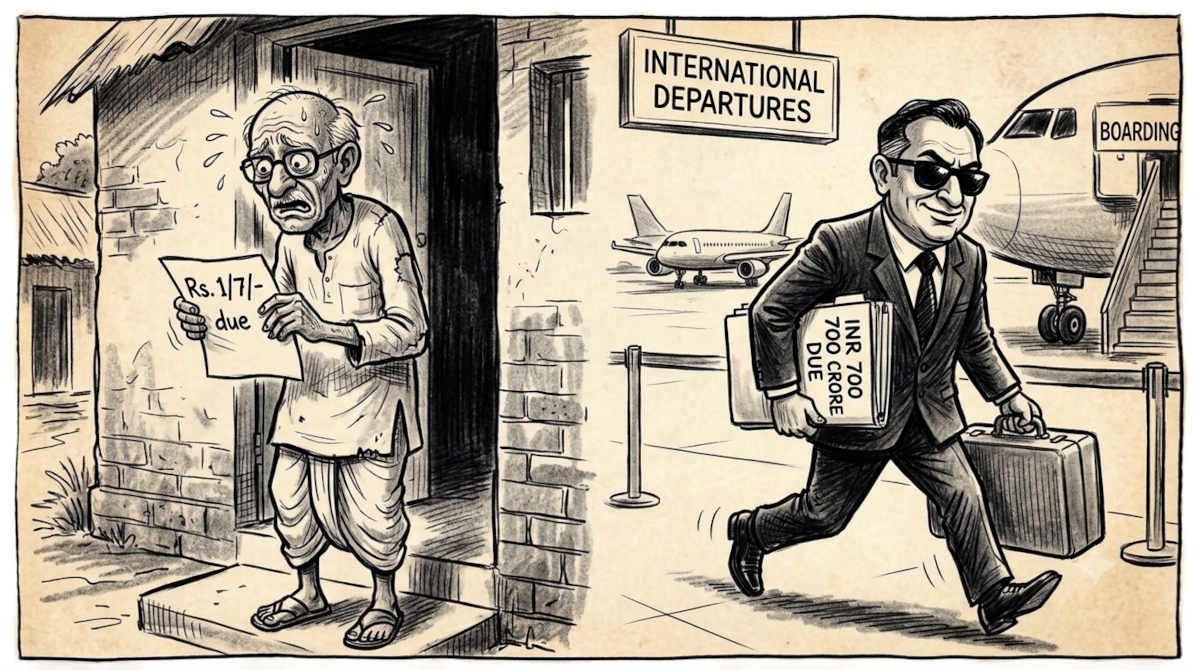
Big Fish Love to Default Government Dues
As Sub-Collector Jajpur, my first posting, I took the quasi-judicial work quite seriously. One important quasi-judicial function is in terms of the Criminal Procedure Code or the CrPC where maintenance of Law and Order is an important task. But I am talking here of cases of another type, civil in nature – ones related to the recovery of Government Dues or the ‘Certificate cases’. If you have defaulted a government due, it cannot be recovered from you unless a due legal process is followed. This due process is governed under the Public Demand Recovery Act and the Sub – Collector as the ‘Certificate Officer’ is assigned the task of hearing these cases and pronounce judgment regarding the recovery to be effected from the defaulter and get the dues recovered through different means including ‘coercive’ ones, such as attachment of a property. In the performance appraisal of the Sub-Collector recovery of Government Dues used to be a formal, important parameter.
One thing that struck me was the pendency of a large number of such cases. So, I decided to keep a specific day of the week when I will dutifully hear these cases and try to dispose these off expeditiously. The assigning of the dates for hearing such cases is usually done by the ‘bench clerk’ – usually an experienced senior clerk. Understandably, he does carry a lot of clout in terms of fixing such dates. I had an experienced bench clerk – Yakub. He was a level headed, systematic worker; an important asset in the pre-computer era of 80s.
Given the large pendency of cases, the next date of hearing of a case would usually be after a large gap. I, in my enthusiasm, or impatience, wanted to give short dates, particularly if the defaulted amount was large. When I suggested that we do the next hearing the next week, Yakub was surprised – ‘such a short date?’. Even the lawyers protested, ‘Sir my client will be busy in agricultural operations.’ I knew this was lame, as the clients could have appeared through their lawyers. The general message conveyed to me was that these are not cases of a pressing nature and Sub-Collector has other important tasks to attend to. It is prudent to let these cases move at their own pace.
I was not quite convinced. I decided to do some ‘rational’ rotation – a mix of one or two big cases, 3-4 medium sized and small sized cases. But to do this I needed the data which the bench clerk would, in my opinion, readily have. But that was not to be. “The pendency is huge, Sir. I have to get all the files, arrange these chronologically and by amount. Making a complete list would be very time taking, Sir.
Was this genuine, or was he sizing me up, the young inexperienced officer? I was very sure he must be thorough with the major cases – how else could he draw his clout from? My ‘theoretical knowledge’ of ABC analysis came in handy. “Okay”, I said, “Get me 20 largest cases and 20 oldest cases. We can fast track these. That should not take time.”
A couple of days later, a slightly anxious Yakub asked me “Do you really want the 10 oldest cases as well? I have got the 10 with largest amount though.”
“What could be the issue with the oldest cases?” I was puzzled. “Are the records missing?”
“No No. Records to hain. Par bahut purane hain” (That would be a sacrilege to the revenue administration – I later learnt in my service that our old record system has really been exemplary – particularly in revenue department.)
“Bahut purane?” I wondered. “Kyaa bees saal purane hain?” (Over twenty years’ old?)
“Usase bhi purane.” Was the nonchalant reply.
It emerged that we had records dating back to the 50s with laughable amounts of few ‘aanas”. In my childhood a rupee used to be 16 anaa – hence the phrase “Solah aane sach.” i.e. 100% true. No wonder these would not have come up for hearing, but such was the ‘dharma’ in the government that these large number of ‘pending’ cases showed up during the review at the district level.
“How do we handle these pending cases?” I asked some of the senior revenue officers in the office and in the field. No one had thought about it. Processing the case would itself have cost us much more that the small amount to be recovered. But we could not close the cases as the recovery of government dues was sacrosanct!
Nevertheless, I decided to press on with the larger cases. My naivete led me to take the case with the largest amount. It had not come up for hearing for quite some time and past few times the hearing had been adjourned.
“Why has this case not been taken up?” I asked. “Oh, it is actually Govind Babu’s case (name changed).”
“Which Govind Babu?”
“Wo jo ex-minister thhe.” He was dropping a broad hint. I refused to take it. “So what? In fact that is all the more reason that the case should be heard.”
Yakub obviously was not impressed with this logic. “Thoda time lagega. Unke vakeel ko khojna padega. Unko khabar dena hoga.”
“Fifteen days. The case is open and shut. Let his lawyer argue. We need to decide it early.”
The word went around. Govind Babu’s lawyer came up with a prayer. Paying part of the dues and some more time to prepare for argument. The ball had started rolling. Other ‘big defaulters’, all influential people, took the hint.
While this was happening at one end, the finance officer brought a case before me with certain ‘write off’ proposals. It seemed that I as the Sub-Collector had the power to write off government dues up to a small amount, some paltry 100 rupees I think. This gave me an idea. Can I also write off some land revenue tax and other dues that are unpaid? He was puzzled. Why would I do so. I mentioned the cases of the 50s where I had princely sums of few annaas or few rupees, that were uncollectable. He sought some time, consulted some of his experienced colleagues and the opined that this could be done.
I called Yakub and asked him to get ten very old, if not the oldest, petty amount cases. He was curious. “Unkaa kyaa karenge?”
“Watch me passing a speaking order.” I said.
On each of the judgment side note – sheet, I wrote a speaking order as to why the dues were uncollectable, the cost of collection would far outweigh the amount involved. Besides, the original individual may be no more. Under the given circumstances I was writing off the above amount under the power available to be for write off.
Yakub was very uncomfortable. He cautioned me against a possible audit objection later where I could be held accountable for loss of government revenue. I remained unmoved. In fact I bundled these cases in lots where the total write off would be around Rs 75 to 80/- and started disposing these off in one ‘hearing’. So the chaff was removed fast. At the same time, the ‘big fish’ case hearing got fast tracked with strict control over adjournments. So, the amount recovered went up considerably.
In the district review meeting Jajpur sub-division stood up in terms of the amount recovered and the cases disposed. The Collector, Mr Harmohan Pattnaik, a very fine boss, looked little suspicious and asked me if I had verified these figures. I nodded in affirmation.
At the lunch-brake, he asked me to accompany him home. That meant trouble. He asked me in the car “What have you been up to, this time?”
“Up to what Sir?” an innocent me asked. “These Certificate Cases. I can understand the large amount recovered, but how could such large number of cases get disposed of.”
I explained to him the pending cases of the 50s and the 60s and my use of ‘write off’ powers. He had a hearty laugh and said “Good luck to your pension.”
I have retired from the service honourably in 2015!